Understanding the North St. Paul Area Market
North St. Paul is a compact, established, largely residential community within Ramsey County, making it an attractive, high‑frequency environment for North St. Paul billboards and other nearby out‑of‑home placements.
-
Population & households
- North St. Paul had 12,613 residents as of 2020, and recent local planning estimates put the population in the 12,800–13,000 range by the mid‑2020s.
- Those residents are organized into roughly 5,200 households, with an average household size near 2.4–2.5 people.
- About 60–65% of housing units are owner‑occupied, signaling a stable base of long‑term residents and homeowners.
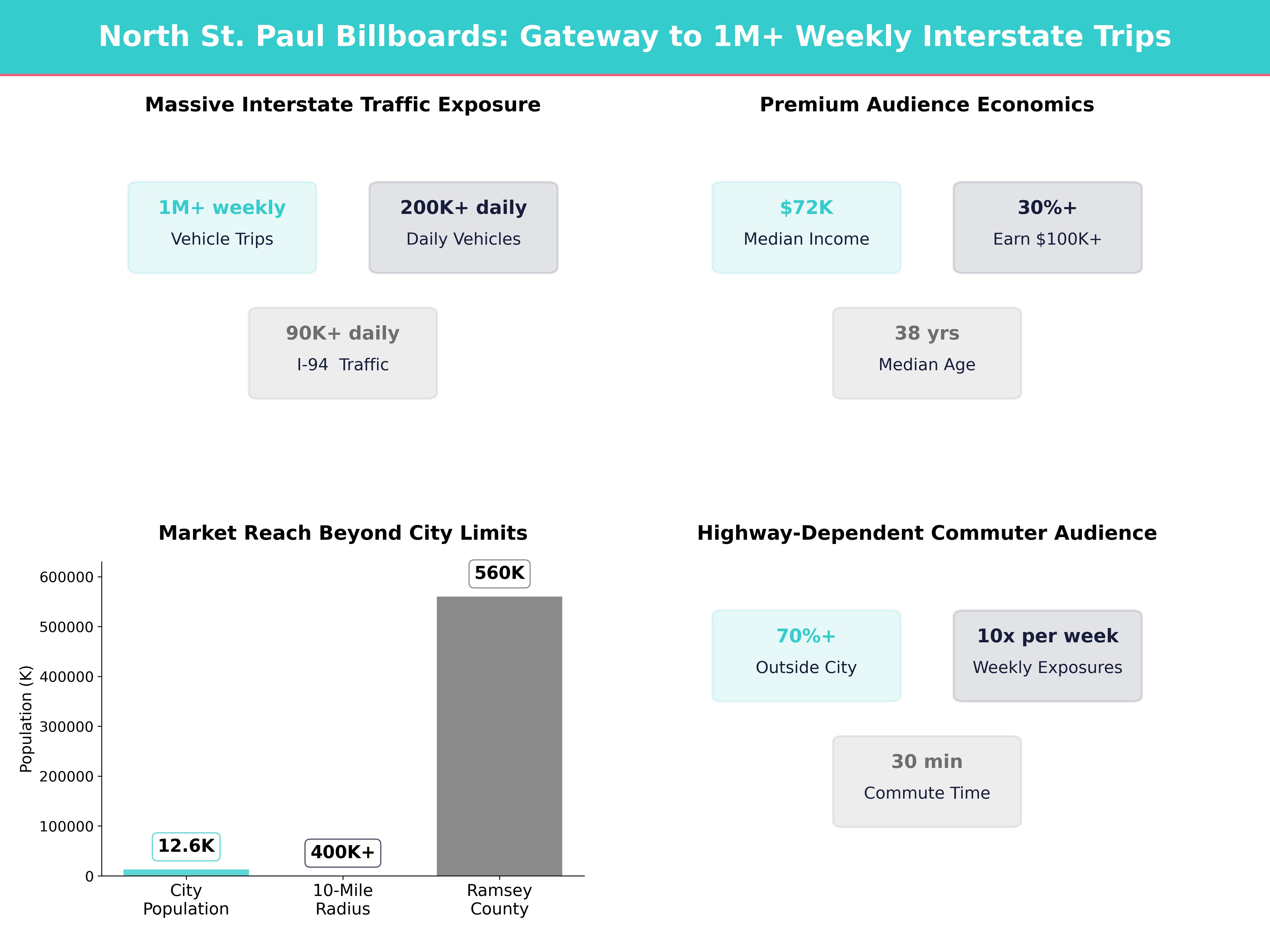
- Ramsey County overall is home to about 560,000 residents, while the Minneapolis–St. Paul metro exceeds 3.7 million people, meaning campaigns serving the North St. Paul area can tap both local and regional audiences.
- Within roughly a 10‑mile radius of North St. Paul, you can reach 400,000+ residents, including key neighboring communities like Maplewood, Oakdale, and White Bear Lake
-
Age & family structure
- Median age in the North St. Paul area hovers around 38 years, similar to the broader metro, with a balanced mix of young families, working‑age adults, and older residents.
- Children under 18 make up roughly 22–24% of the population, while adults 25–54 (prime working years) account for about 37–40%.
- Around 45–50% of households are family households, and about 30–35% of households include children under 18, which aligns with the presence of neighborhood schools and youth sports programs throughout ISD 622 – North St. Paul–Maplewood–Oakdale.
- The school district serves approximately 10,000–11,000 students across its schools, creating ongoing demand for youth‑oriented services, activities, and family spending that can be reinforced through billboard advertising near North St. Paul.
-
Income & spending power
- Median household income in North St. Paul is in the low‑ to mid‑$70,000s (roughly $72,000–$75,000), slightly below some west‑metro suburbs but firmly middle‑income.
- Ramsey County’s median household income is around $71,000, with a sizable share of households—about 30–35%—earning $100,000 or more, supporting discretionary spending on travel, dining, and services.
- In the Twin Cities metro overall, consumer spending on categories like food at home, food away from home, transportation, and healthcare regularly exceeds national per‑capita averages by several percentage points, reflecting strong regional purchasing power.
- Major employment sectors for local residents include education and health services (25–30%), professional and business services (15–20%), public administration (10%+), and retail, hospitality, and leisure (15–20%), all sectors that support stable year‑round purchasing.
What this implies for billboard advertisers:
- Messaging should speak to value, reliability, and family‑oriented benefits, not just luxury—especially since roughly half of households fall into middle‑income bands between $50,000 and $125,000.
- Everyday categories—grocery, quick‑service restaurants, automotive services, home improvement, local healthcare, and financial services—can perform very well because they map directly to the top five household spending categories in the metro.
- Because an estimated 70–80% of employed residents in similar east‑metro cities work outside their city of residence, you’re reaching both local decision‑makers and workers from other suburbs and St. Paul who pass near North St. Paul daily.
To dive deeper into the local environment, review the City of North St. Paul site and Ramsey County resources. For broader regional context, the Metropolitan Council publishes additional demographic and economic data for the Twin Cities region.
How Our Nearby Billboards Reach the North St. Paul Area
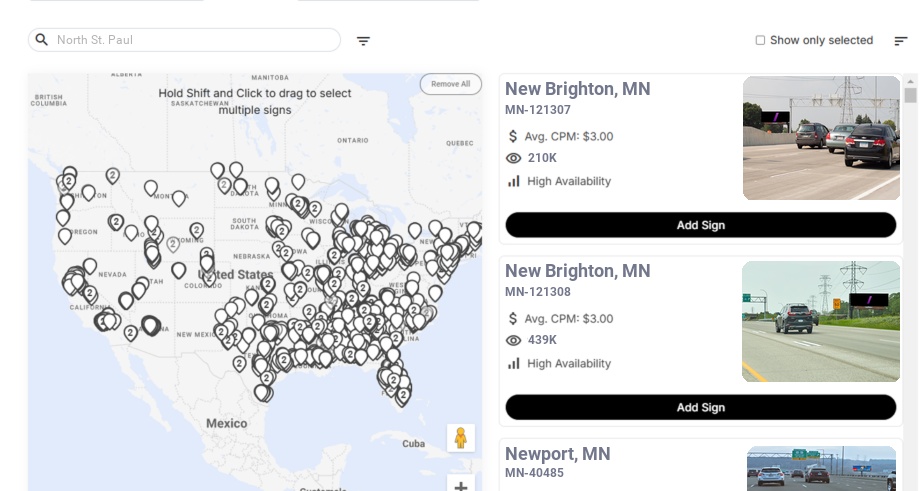
Our 9 digital billboards serving the North St. Paul area are located in:
- Newport, MN – about 9.0 miles from North St. Paul
- New Brighton, MN – about 9.5 miles from North St. Paul
These locations place your message along key commuter and shopping routes that residents of the North St. Paul area use frequently, offering some of the most efficient billboards near North St. Paul for brands that want exposure on major freeways without paying downtown premiums.
- Highway 36: The main east‑west artery for North St. Paul and Maplewood, connecting to I‑35E and I‑694. The Minnesota Department of Transportation (MnDOT) reports average daily traffic volumes in the 60,000–80,000 vehicles per day range along segments near the area. Even modest roadside capture rates (for example, 2–4% of drivers noticing a board per pass) can translate into 1,200–3,000 daily impressions for a single creative.
-
I‑94 & I‑494 near Newport:
- I‑94 east of St. Paul typically sees 90,000–130,000 vehicles per day, with weekday peaks often 15–25% higher than weekend volumes.
- I‑494 along the southeast beltway near Newport typically ranges from 70,000–100,000 vehicles per day.
- Combined, the I‑94/I‑494 interchange area can expose a well‑positioned board to over 1 million vehicle trips per week, a key reason national and regional brands favor this corridor.
-
I‑35W & I‑694 near New Brighton:
- I‑35W north of Minneapolis can exceed 120,000 vehicles per day along some segments.
- I‑694 in the north metro often carries 80,000–110,000 vehicles per day.
- The I‑35W/I‑694 junction alone can account for 1.1–1.4 million vehicles weekly, including commuters, delivery fleets, and regional shoppers heading to key retail centers like Rosedale Center.
Because many North St. Paul area residents commute toward downtown St. Paul, the east metro, or the north metro, boards in Newport and New Brighton effectively intercept these flows at high‑density choke points. For a typical five‑day workweek, a regular commuter on these corridors might pass a given board 10 times per week (twice daily), enabling high frequency at relatively modest budgets, and making billboard rental near North St. Paul a cost‑effective way to stay top‑of‑mind.
Key strategic insights:
-
Use Newport boards to target:
- Residents heading toward Cottage Grove, Woodbury, and south/east St. Paul, many of whom travel I‑94 or I‑494 daily.
- Truck and logistics traffic moving along I‑94 / I‑494; freight and logistics employment accounts for 5–7% of metro jobs, and these drivers frequently use repeated, predictable routes.
-
Use New Brighton boards to target:
- North St. Paul area residents commuting to north metro employment hubs (New Brighton, Roseville, Shoreview, Arden Hills), which together host tens of thousands of office, industrial, and research jobs.
- Shoppers heading toward Rosedale and other major retail districts; Rosedale alone draws millions of visits annually, reinforcing the value of visibility on these approaches.
With Blip, we can dynamically allocate impressions between these locations so your campaigns follow the commuting patterns that matter most to your audience, weighting your spend toward corridors with the highest overlap between your ideal customers and the 200,000+ combined average daily vehicles moving through the Newport and New Brighton areas.
Commuter Behavior and Daily Movement Patterns
The North St. Paul area is highly commuter‑oriented, which is why billboard advertising near North St. Paul consistently delivers repeat exposure to the same audiences:
- In many east‑metro suburbs, 70–80% of employed residents work outside their city of residence, and regional surveys indicate roughly 50–55% drive alone, 8–10% carpool, and 5–10% use transit, with the balance working from home or using other modes.
- Average commute times in the Twin Cities are around 25 minutes, but east‑metro workers commuting to downtown or across the metro often see 30–35 minute drives, especially in peak periods. That translates to 4–5 hours per week spent on the road for many full‑time workers.
- Roughly 60–65% of workers in the metro leave for work between 6:00 a.m. and 9:00 a.m., which lines up closely with prime billboard viewing windows.
-
Key destinations for North St. Paul area commuters include:
- Downtown St. Paul (state government, banking, corporate offices, events at Rice Park and the Ordway Center).
- Maplewood (notably the 3M global headquarters, medical clinics, and retail).
- Roseville/New Brighton (office parks, light industrial, retail, and higher education campuses).
- Minneapolis core and University of Minnesota campuses, including thousands of students and staff who traverse east‑metro freeways daily.
What that means for scheduling:
-
Morning drive (6:30–9:30 a.m.)
Target North St. Paul area residents as they head toward New Brighton, Roseville, downtown St. Paul, and the broader metro. Local traffic counts show AM peak hour volumes can be 25–35% higher than mid‑day on many segments.
- Ideal for coffee, breakfast, transit, automotive, and service reminders (“book today,” “open at 8 a.m.”).
-
Evening drive (3:30–7:00 p.m.)
Capture commuters returning through the corridor, now in a home‑oriented mindset. Evening peak volumes often mirror the morning, with slightly more congestion on Thursdays and Fridays, when leisure and shopping trips spike.
- Ideal for grocery, restaurants, entertainment, home services, health care, and local events.
-
Midday (10:00 a.m.–3:00 p.m.)
Reaches local errands, retirees, shift workers, and service workers. In many metro areas, 20–25% of daily traffic occurs during this window.
- Ideal for medical and dental appointments, retail, city services, and B2B.
Using Blip’s dayparting and budget tools, we can concentrate spend heavily on these AM and PM peaks, especially on Newport and New Brighton boards that align with the most common commute routes used by North St. Paul area residents.
For additional transit and commuting context, the Metropolitan Council and Metro Transit share regional mobility data and route information for the Twin Cities area.
Seasonal Trends and Local Events to Leverage
Minnesota’s strong seasonality dramatically changes behavior—and billboard opportunities—in the North St. Paul area.
Winter (November–March)
- The Twin Cities frequently records over 50 inches of snowfall annually, with some winters topping 60 inches.
- Average highs from December to February hover in the 20s°F, with frequent single‑digit mornings and wind chills below 0°F during cold snaps.
- Dark commutes dominate: in December, sunrise is around 7:45 a.m. and sunset near 4:30 p.m., leaving 9+ hours of darkness during typical commuting windows.
- Winter weather can slow traffic speeds by 10–20% and increase travel times by 15–30%, which actually increases exposure time for billboard messages.
Implications for creatives and timing:
- Use bold, high‑contrast colors against dark or snowy backdrops; visibility tests show high‑contrast designs can improve legibility distance by 30–50% in low‑light conditions.
- Emphasize short, legible messages—drivers are more cautious in slick conditions and typically have 2–4 seconds to absorb a message.
-
Great time to promote:
- Auto repair, tires, towing, and insurance, as crash rates often rise 10–20% during major snow events.
- Home heating, plumbing, roofing, and snow removal, responding to increased calls for furnace service and frozen pipe repairs.
- Indoor entertainment (gyms, movie theaters, bowling, escape rooms), especially on weekends when cabin fever sets in.
- Tax preparation (January–April), as local tax preparers and financial advisors experience their annual peak.
Spring & Summer (April–August)
- Average highs climb from the 50s°F in April to the 80s°F in July, and the metro typically enjoys 200+ sunny or partly sunny days per year.
- Warmer months generate a major uptick in road trips, youth sports, and events. State tourism data show the warm‑weather travel season accounts for a disproportionate share—often 40–50%—of annual leisure travel spending.
- Explore Minnesota Explore Minnesota – Metro Region
- Local outdoor amenities—lakes, trails, parks—see high use, and weekend traffic spikes near recreational areas and festivals. Weekend traffic volumes on some recreational routes can rise 20–30% compared to non‑summer periods.
Key local hooks:
- North St. Paul’s History Cruze Car Show, a long‑running weekly summer event, brings classic cars and spectators into the downtown area Thursday evenings. Attendance can climb into the hundreds or low thousands on favorable evenings, with visitors driving in from multiple east‑metro communities. Local coverage from outlets like the St. Paul Pioneer Press (TwinCities.com) and community news sections often highlights east‑metro events like these.
- Local farmers markets, youth sports tournaments, and city celebrations pull in families from neighboring communities such as Maplewood, Oakdale, and White Bear Lake. Many of these events appear on the City of North St. Paul community calendar and on Ramsey County parks and recreation pages (Ramsey County – Parks & Recreation).
Summer creative strategies:
- Highlight events, attractions, and limited‑time offers—studies consistently show urgency‑based messages can lift response rates by 10–20%.
- Focus on weekend pushes, increasing bids for Thursday–Sunday on boards along major outbound and return routes.
- Promote HVAC tune‑ups, outdoor dining, home projects, and tourism/attractions as households typically shift more spending into home improvement, recreation, and travel during these months.
Back‑to‑School & Fall (September–October)
- Families shift back to school routines through ISD 622 – North St. Paul–Maplewood–Oakdale and surrounding districts. For many households, August and September include multiple large‑ticket purchases—technology, clothing, sports gear, and school fees.
- Regional retail reports often peg back‑to‑school as the second‑largest shopping season of the year, behind the winter holidays, accounting for billions in national spending and a substantial local share.
-
Retailers and services can capitalize on:
- Back‑to‑school shopping (clothing, supplies, tech).
- After‑school activities (music, tutoring, sports, clubs), which often see enrollment spikes of 20–30% in late August and early September.
- Health and dental checkups, vaccinations, eye exams, and sports physicals as families rush to meet school and sports requirements.
Blip campaigns can ramp up in late July and August to lock in awareness before the school year starts, then pivot messaging in September toward fall maintenance, flu shots, and financial planning. Holiday‑prep messaging can begin as early as late October, when many retailers start their first major seasonal pushes.
Audience Segments to Target Near North St. Paul
Because our billboards serve the North St. Paul area from a regional vantage point, you can design campaigns for several high‑value segments and match them to the most relevant North St. Paul billboards and surrounding corridors:
-
Local Families and Homeowners
- North St. Paul is primarily single‑family homes and low‑rise multifamily, with homeownership rates around 60–65% and a median home value in the mid‑$200,000s to low‑$300,000s.
- Roughly 1 in 3 households includes children, and many participate in school, youth sports, and church‑based activities, leading to repeated daily and weekly travel along the same corridors.
- Family‑centric messaging (education, safety, savings, time‑saving services) will resonate.
- Ideal advertisers: home services, childcare, healthcare, family dining, local events, financial services.
-
Commuting Professionals
- Many residents work in St. Paul, Roseville/New Brighton, and across the metro; office and professional jobs account for a large share of regional employment.
- They see your boards twice a day, 5 days a week—perfect for frequency‑driven branding. Even at conservative viewing assumptions, a daily commuter could see your message 40–60 times per month.
- Ideal advertisers: banks, insurance, telecom, higher education, auto dealers, subscription services.
-
Blue‑Collar and Industrial Workforce
- The east metro features logistics, manufacturing, and industrial hubs along I‑494, I‑35E, and I‑94, with tens of thousands of jobs in manufacturing, transportation, warehousing, and utilities.
- Newport‑area boards are particularly strong for reaching trucking, warehousing, and industrial traffic, including regional freight corridors serving the Port of St. Paul via the Saint Paul Port Authority
- Ideal advertisers: recruiting/staffing agencies, training programs, industrial suppliers, truck stops and repair.
-
Visitors to the Twin Cities and East Metro
- The Twin Cities region welcomes tens of millions of visitors annually, with a substantial share spending time in Saint Paul for events, sports, museums, and conferences.
- Visitors heading toward St. Paul, the Minnesota State Capitol, Xcel Energy Center, and regional attractions often travel the same corridors that pass near North St. Paul.
- Tourism marketing from Visit Saint Paul highlights drawcards like events, museums, and sports.
- Ideal advertisers: hotels, attractions, casinos, dining, events, and entertainment venues.
With Blip’s flexible buying, we can deploy different creatives for each segment on the same boards, rotating based on time of day and even day of week, aligning with when each group is most likely to be on the road.
Creative Best Practices for the North St. Paul Area
To make the most of our 9 digital billboards serving the North St. Paul area, we recommend:
Keep It Simple and Local
Because most exposure happens at freeway and highway speeds:
- Limit copy to 7 words or fewer and focus on a single call to action. Readability research on roadside displays shows comprehension drops sharply beyond 6–8 words at typical highway speeds.
- Use large, high‑contrast fonts (white/yellow on dark, or dark on light). For maximum legibility, key text should be at least 18–24 inches tall on a full‑size digital board.
-
Integrate local references:
- “Minutes from North St. Paul”
- “Serving North St. Paul families”
- “Just off Hwy 36” or “Near I‑494 at [exit]”
- Local orientation reassures drivers that your service is convenient and relevant to their daily routes and can increase response among nearby residents by 10–30%, based on typical localized‑messaging lift studies.
Tailor Creative to Weather and Season
- Winter: Use warm imagery, bold colors, and “before the storm” or “stay safe” messaging to tap into weather‑driven urgency.
- Summer: Use bright, clean visuals, outdoor themes, and limited‑time offers (“this weekend only,” “summer special”), capitalizing on increased discretionary travel and weekend trips.
- Fall/Spring: Lean into transitions (back‑to‑school, tax season, spring cleaning, fall maintenance), as households often cluster big decisions and purchases in these periods.
Because digital billboards allow quick creative swaps, we can adjust artwork to reflect first snowfall, heat waves, or major local events like city festivals, sports playoffs, or concerts at venues featured on Visit Saint Paul.
Feature Clear Directions and Next Steps
Residents in the North St. Paul area know their arterial roads—Hwy 36, Hwy 61, I‑94, I‑35E, I‑694, I‑494. Use that:
- “Exit at Hwy 36 and [street]”
- “5 minutes west of North St. Paul on 36”
- “Off I‑494 in Newport – Next Exit”
Pair this with a simple conversion action:
- “Book online at [SHORT URL]”
- “Call today: [phone]”
- “Scan to save” (if you anticipate slower traffic or stoplights, such as boards closer to surface streets or interchanges).
Short, explicit calls‑to‑action can meaningfully improve response; many advertisers see 10–25% higher recall and response when the next step is crystal clear.
Using Blip’s Tools Strategically for the North St. Paul Area
Blip’s model—buying individual “blips” of airtime instead of full‑time loops—lets us shape campaigns precisely around North St. Paul‑area behavior, whether you’re testing billboard advertising near North St. Paul for the first time or scaling a proven campaign.
Here’s how to maximize that advantage:
1. Dayparting by Corridor
-
Newport boards
- Heavier during AM inbound and PM outbound commuting windows, when I‑94 and I‑494 volumes are at their peak.
- Focus on commuters traveling between North St. Paul, Woodbury, south St. Paul, and Cottage Grove—corridors that can see tens of thousands of vehicles in each peak period.
-
New Brighton boards
- Target northbound AM and southbound PM to catch residents working in Roseville, Arden Hills, Shoreview, and the north metro.
- Consider midday blocks to reach shoppers headed to Rosedale and nearby retail clusters.
-
Consider separate AM/PM creatives:
- Morning: “Today only,” “Schedule before 10 a.m.,” “Open now.”
- Evening: “Open late,” “Order for tonight,” “Plan this weekend.”
Using dayparting, you can place 70–80% of impressions in the 40–50% of hours that deliver the greatest commuting density.
2. Geographic Blending
Use Blip to distribute impressions strategically:
-
Example:
- 60% of budget on Newport boards (to hit I‑94/I‑494 and east‑metro flows).
- 40% of budget on New Brighton boards (to capture north‑metro commuters and shoppers).
-
Adjust this mix based on:
- Where your physical business is located.
- Which customer ZIP codes you rely on most.
- Whether your audience tends to work north, south, east, or west of the North St. Paul area.
For instance, a business in Maplewood or Oakdale might devote 70%+ of its spend to Newport and Hwy 36‑adjacent boards, while a company in Roseville or Shoreview might invert that ratio.
3. Flighting Around Key Dates
Build campaigns around local and regional peaks:
- Tax season (Feb–April) for financial services; many preparers derive 40–60% of annual revenue in this window.
- Graduation and prom season (May–June) for florists, photographers, formalwear, and venues—local high schools and colleges collectively produce thousands of graduates each year.
- Summer festivals & car shows, including North St. Paul’s weekly summer gatherings and other events listed on city and county calendars.
- Back‑to‑school (late July–September) for education, healthcare, retail.
- Holiday season (November–December) for retail, nonprofits, events; national data often show 20–25% of annual retail sales occurring during this season, with a strong echo locally.
Blip makes it easy to run short, high‑impact flights (e.g., 10–14 days) around these windows rather than paying for long periods of lower relevance.
4. A/B Testing Multiple Creatives
Because each “blip” can show different artwork:
- Test two or three versions of your message with small spends (e.g., allocate 20–30% of budget to testing).
- Track website traffic, direct response, or store visits during each test segment.
- Promote the top‑performing creative for the remainder of your budget.
For example:
- Creative A: “North St. Paul Family Dentist – Same‑Day Appointments”
- Creative B: “Get Seen Faster – Dentist Near North St. Paul”
- Creative C: “New Patients Save 20% – Book Today”
Run each for a week, compare performance metrics such as click‑throughs on branded search ads, call volume, or appointment bookings, then scale the winner. It’s common to see 15–30% performance differences between the best‑ and worst‑performing creatives.
Integrating Billboards with Your Broader Marketing
Digital billboards serving the North St. Paul area work best when integrated with your other channels.
-
Search & Maps
- Use the same keywords and messaging (“North St. Paul area,” “near Hwy 36”) in Google Ads and your Google Business Profile so users searching for services or billboards near North St. Paul see a consistent story.
- Many drivers who see your board will search your name or category later; branded search often increases 10–40% during well‑executed billboard flights.
-
Social Media
- Showcase your billboard creative on platforms like Facebook and Instagram, tagging North St. Paul, Maplewood, Oakdale, and other nearby communities.
- Run geofenced campaigns around the corridors where our boards are located to reinforce frequency. Studies regularly show cross‑channel campaigns can lift ad recall by 20–30% compared to siloed efforts.
-
Local News & Sponsorships
- Pair billboard flights with sponsorships or ads on regional outlets such as the St. Paul Pioneer Press (TwinCities.com) or Star Tribune ( Star Tribune
- Sponsor local programs or events featured on the City of North St. Paul or Ramsey County calendars, then echo those sponsorships in your billboard creative. Local sponsorships often improve community recognition and favorability among residents by double‑digit percentage points in post‑campaign surveys.
-
Tracking and Attribution
- Use vanity URLs, unique phone numbers, or promotional codes only mentioned on billboards to measure response.
- Monitor changes in branded search volume and direct type‑in traffic to your website in the weeks your campaign is live.
- For brick‑and‑mortar locations, ask new customers “How did you hear about us?” and track the percentage citing billboards; many local businesses see 5–15% of new customers referencing out‑of‑home when it’s active.
Putting It All Together for the North St. Paul Area
The North St. Paul area combines small‑town relationships with metro‑scale traffic. With 9 digital billboards positioned nearby in Newport and New Brighton, we can help you:
- Reach tens of thousands of commuters daily along I‑94, I‑494, I‑35W, I‑694, and Hwy 36, translating into hundreds of thousands of weekly impressions.
- Speak directly to families, commuters, and workers who live near North St. Paul but work and shop across the Twin Cities.
- Adjust campaigns quickly around seasons, weather, local events, and promotions, taking advantage of Minnesota’s strong seasonal swings and active local event calendar.
- Start with modest budgets and scale only when you see measurable impact, using Blip’s flexible bidding, dayparting, creative rotation tools, and easy billboard rental near North St. Paul.
By aligning your targeting, scheduling, and creative with the way people in the North St. Paul area actually live and move, digital billboards through Blip become a powerful, flexible backbone of your local marketing strategy.