Understanding the New Hope Area Market
New Hope is a mature first-ring suburb of Minneapolis with a strong mix of families, long‑time residents, and small businesses—an ideal audience for New Hope billboards and other neighborhood-focused media.
-
Population size and density
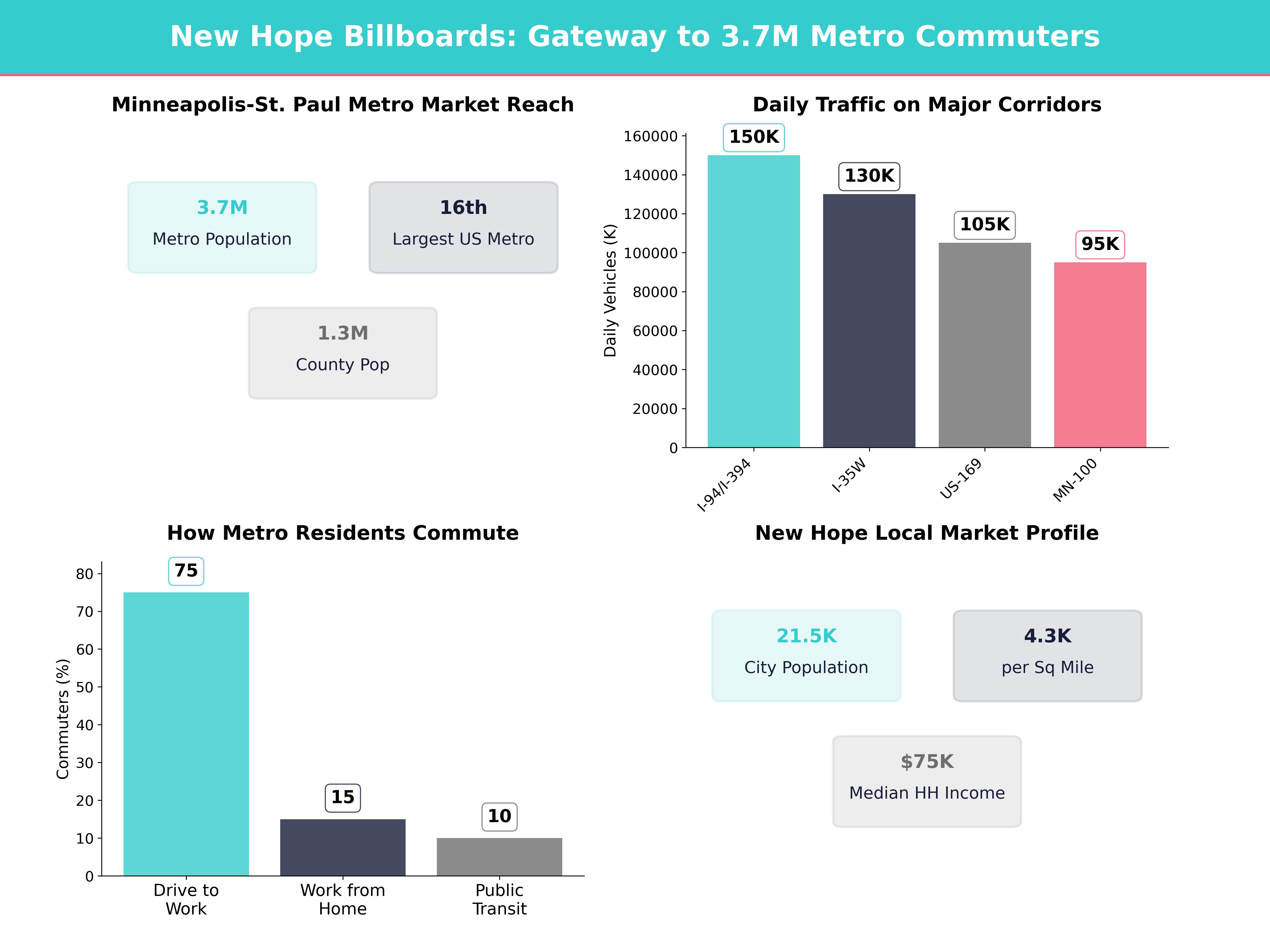
- The City of New Hope 21,000–22,000 residents in about 5 square miles, for a density of approximately 4,300 people per square mile—substantially denser than many second‑ and third‑ring suburbs in the Twin Cities.
- New Hope is part of Hennepin County, which has around 1.3 million residents and accounts for roughly 35% of Minnesota’s total population, according to county planning data.
- The greater Minneapolis–St. Paul metro area is home to about 3.7 million people, representing nearly two‑thirds of Minnesota’s population and workforce, making this one of the 20 largest metro areas in the U.S.
-
Household and income profile
- New Hope’s median household income is commonly reported in the $70,000–$80,000 range, aligning closely with the broader Twin Cities median (around $82,000), and placing it above both the Minnesota and national medians.
- Approximately 65–70% of housing units in the New Hope area are owner‑occupied, indicating a relatively stable community with strong roots and predictable purchasing patterns.
- In nearby northwest suburbs (Crystal, Robbinsdale, Brooklyn Park, Brooklyn Center, Golden Valley), homeownership rates often fall between 55–75%, and many homes were built in the 1950s–1970s—an important indicator of ongoing demand for home maintenance, remodeling, and exterior improvements, all of which respond well to billboard advertising near New Hope.
-
Age and family structure
- New Hope and adjacent communities have a balanced age profile, with a strong concentration of residents in the 30–54 age band and sizable populations of children and teens. Regional school district data from Robbinsdale Area Schools (ISD 281), which serves New Hope and nearby cities, shows 11,000+ students across its schools.
- The share of households with children under 18 in these northwest suburbs generally ranges from 28–35%, sustaining strong demand for family‑oriented services, youth activities, and education support.
For more context on local priorities, development projects, parks, and community events, advertisers can reference the City of New Hope Hennepin County’s portal. Local coverage from CCX Media, which serves New Hope and neighboring communities, is also useful for gauging community issues and interests and aligning New Hope billboards with timely topics.
Implication for billboard strategy: Near New Hope, campaigns that speak to family life, home improvement, health and wellness, and local convenience will resonate. The relatively high homeownership rate and mid‑to‑upper‑middle‑income profile mean that messaging emphasizing quality, reliability, and neighborhood roots—rather than deep discounting alone—tends to perform best, especially when it feels “hyper‑local” and community‑minded. When you use billboards near New Hope with this type of creative, your message mirrors how residents see their own community.
How People Move Around the New Hope Area
Blip’s digital billboards serving the New Hope area sit along major Twin Cities arteries that New Hope residents use every day, which makes billboard advertising near New Hope a natural fit for capturing commuter and shopping traffic.
-
Commuting patterns
- In the northwest Twin Cities suburbs, about 70–75% of workers commute by car, truck, or van, with a large majority driving alone.
- Transit use (bus and light rail combined) in the broader Minneapolis area accounts for roughly 8–10% of commute trips, with an additional 2–4% walking or biking and 10–15% working from home in recent regional surveys.
- According to regional transportation reports, the average one‑way commute in the Minneapolis–St. Paul area is about 24–25 minutes, creating multiple daily exposure opportunities for drivers passing digital billboards.
- Metro Transit, which operates buses and light rail serving Minneapolis and many suburbs, reports average weekday ridership of around 180,000–200,000 rides.
-
Traffic volumes near New Hope
-
The Minnesota Department of Transportation (MnDOT) documents high traffic volumes on freeways surrounding New Hope:
- US‑169 near the New Hope/Golden Valley corridor typically carries around 90,000–105,000 vehicles per day on key segments.
- MN‑100 through nearby Robbinsdale and Crystal handles approximately 80,000–95,000 vehicles per day.
- Closer to downtown, I‑94 and I‑394 each carry in the range of 120,000–150,000 vehicles per day on busy stretches.
- I‑35W through Minneapolis often exceeds 110,000–130,000 vehicles per day on central segments.
-
Important surface streets and arterials that New Hope residents and workers frequently use include:
- County Road 81 / Bottineau Boulevard, where MnDOT and county counts show 25,000–35,000 vehicles per day on busier segments.
- Brooklyn Boulevard, often reporting 15,000–25,000 vehicles per day depending on the section.
- Other key local connectors, such as Winnetka Avenue and Xerxes Avenue, collectively support thousands of daily trips through residential and commercial corridors.
- You can explore specific traffic count maps, annual average daily traffic (AADT) numbers, and construction impacts via MnDOT to better understand which billboards near New Hope will intersect the heaviest flows.
-
Regional draw
- New Hope residents frequently travel into Minneapolis for work and entertainment. Meet Minneapolis reports that the city welcomed more than 30 million visitors in a recent year, with visitor spending in the billions.
-
Major sports venues and entertainment hubs create predictable traffic surges:
- Target Field (Minnesota Twins) hosts 80+ home games each season, drawing a total attendance often above 1.8–2.0 million per year.
- U.S. Bank Stadium (Minnesota Vikings plus concerts and major events) seats about 66,000 fans, with regular NFL games and special events driving heavy weekend and evening traffic.
- Target Center and nearby theaters collectively host hundreds of events per year, with combined annual attendance in the hundreds of thousands.
- Regional shopping and service destinations such as Brooklyn Center, Crystal, Robbinsdale, Golden Valley, Plymouth, and Maple Grove (including the Arbor Lakes shopping district with more than 200 shops and restaurants) pull New Hope residents across the northern half of the metro.
Implication for billboard strategy: Use billboards near Minneapolis, Spring Lake Park, and New Brighton to intercept New Hope area residents on their regular commute patterns, then reinforce during evening and weekend trips for shopping and entertainment. Lean into high‑traffic windows around rush hours, event times (Twins, Vikings, concerts), and seasonal travel spikes (summer weekends, back‑to‑school, and holiday shopping) to get maximum value from billboard advertising near New Hope.
Leveraging Nearby Billboard Locations to Reach the New Hope Area
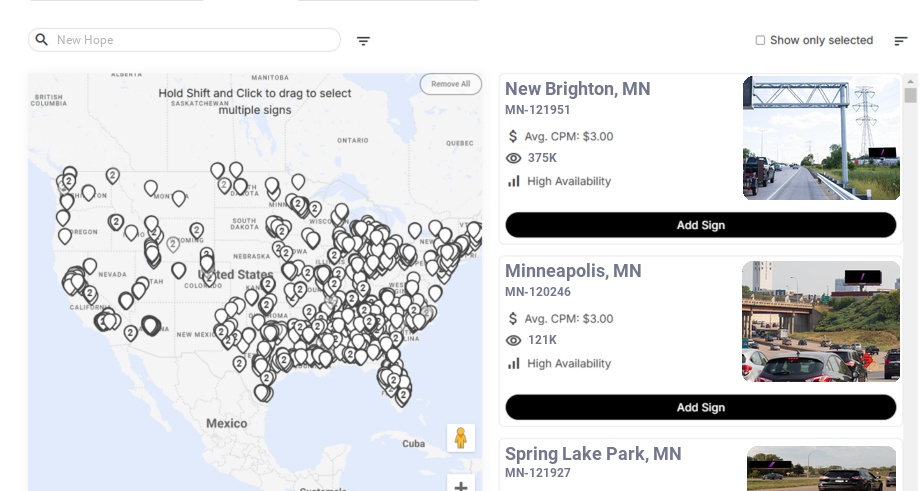
We have 6 digital billboards serving the New Hope area, strategically positioned in:
- Minneapolis (about 8.4 miles from New Hope)
- Spring Lake Park (about 9.1 miles from New Hope)
- New Brighton (about 9.6 miles from New Hope)
These locations align with traffic corridors that routinely see tens of thousands of daily vehicles and are ideal for advertisers seeking flexible billboard rental near New Hope.
-
Inbound commuting corridors
- Target residents leaving the New Hope area in the morning and returning in the evening via routes like US‑169, MN‑100, I‑94, I‑394, and I‑35W.
- In the broader metro, weekday peak‑period volumes can climb 15–30% above daily averages, increasing impressions per digital slot.
-
Align messages with trip purpose:
- Morning (6–9 AM): quick‑service food, coffee, traffic/weather alerts, job opportunities, financial reminders.
- Evening (4–7 PM): grocery stops, family dining, fitness, home services, and healthcare reminders.
-
Cross‑suburb traffic
- Many New Hope residents work, shop, or receive services in suburbs northeast or northwest of Minneapolis. Commuter surveys in the region show that more than 40% of workers in some suburbs travel to a different suburb (rather than downtown) for work.
- Boards in Spring Lake Park and New Brighton are well positioned to reach drivers using the northern belt of the metro, including connections to I‑35W, Highway 65, and I‑694—routes where daily traffic often exceeds 80,000–100,000 vehicles on busy segments. This makes them highly effective as New Hope billboards for cross‑suburb audiences.
-
Destination‑driven traffic
- Minneapolis boards catch New Hope area residents going to concerts, pro sports, and downtown events. Many of these events draw 10,000–60,000+ attendees, creating concentrated peaks in pre‑ and post‑event travel.
- Coordinate campaigns with major events via Meet Minneapolis and Explore Minnesota
Implication for billboard strategy: Think in terms of “corridors,” not just city labels. Choose Blip boards based on where New Hope area residents are headed and at what times. Use dayparting and budget controls to dominate specific flows—such as inbound commuters in the morning, returning shoppers in the early evening, or fans heading to weekend games and concerts. This corridor‑based approach turns simple billboard rental near New Hope into a tailored coverage plan.
Crafting Creative That Fits the New Hope Area
To succeed on digital billboards serving the New Hope area, artwork needs to be tailored to local sensibilities and quick roadside viewing so your New Hope billboards communicate clearly in just a few seconds.
1. Visual style and color
- Use high contrast combinations (e.g., dark background + bright text, or white background + bold color). MnDOT safety guidance and national OOH research both suggest that high‑contrast messages can be recognized 30–50% faster at highway speeds.
- Limit text to 7–10 words or fewer; at 55–65 mph, drivers typically have 6–8 seconds or less to see and process your message.
-
Incorporate simple icons or imagery relevant to the New Hope area:
- Houses, backyards, family activities, pets, or recognizable neighborhood scenes.
- Seasonal visuals: snow / winter sports in Dec–Feb, lakes and green space May–Sept, fall colors Sept–Nov. For inspiration, review New Hope parks and recreation imagery at the city’s Parks & Recreation pages via the City of New Hope
2. Localized messaging
Residents strongly identify with their suburb and nearby communities. Local media like CCX Media frequently highlight neighborhood stories, reinforcing this identity.
Consider:
-
Headlines such as:
- “Home Services Trusted by New Hope Area Families”
- “Tonight’s Dinner, Just Minutes from New Hope”
- “New Hope Area Parents: Enroll Before Season Starts”
-
Explicit mentions of nearby landmarks or cross‑streets:
- “Off 42nd & Winnetka”
- “Near Crystal Airport”
- “5 Minutes from Hwy 169”
- Including drive‑time messages (e.g., “3 minutes from New Hope” or “Exit now on 169”) can improve response by giving drivers a specific mental map and urgency. This type of hyper‑local copy is especially powerful on billboards near New Hope, where people are highly familiar with local routes.
3. Offers that fit the local lifestyle
- Family‑friendly deals (kids eat free, multi‑visit passes, bundle pricing) match the 30%+ of households with children across nearby suburbs.
-
Convenience‑driven messaging:
- “Online booking in 60 seconds”
- “Same‑day appointments near New Hope”
- Value‑oriented but not “bargain basement”: the area’s income levels support quality‑focused offers, especially for home and auto services. Position upgrades (e.g., energy‑efficient windows or premium car washes) rather than only lowest‑price options.
4. Rotating creative with Blip
Because Blip lets you upload multiple designs and rotate them:
-
Run 2–4 variations simultaneously:
- One for awareness (“Your New Hope Area Plumber”)
- One for offer (“$79 Drain Clear Special”)
- One for urgency (“Same‑Day Service if You Call by 3 PM”)
- Optionally, one community‑oriented (“Proud to Serve New Hope Neighbors Since 2010”)
-
Test versions featuring:
- Different calls‑to‑action (call vs. web vs. visit).
- Different community references (“New Hope Area” vs. specific nearby cross‑streets or neighborhoods).
- Industry research often shows that rotating creative every 4–8 weeks can prevent message fatigue and maintain 10–20% higher recall compared to static designs over long periods, especially when your billboard advertising near New Hope is part of an always‑on brand presence.
Timing Your Campaign Around Local Routines
Digital flexibility is most powerful when aligned with how New Hope area residents actually live and move. Smart timing can turn standard New Hope billboards into highly efficient, behavior‑driven touchpoints.
Weekday patterns
-
6–9 AM: Morning commute peaks; MnDOT data show morning peak volumes can be 20–30% higher than mid‑day on key freeways.
- Best for coffee shops, breakfast, traffic apps, radio, podcasts, and service brands planting a mental “to‑do” (banking, medical, home repair).
-
11 AM–2 PM: Lunch and mid‑day errands:
- Quick‑service restaurants, local lunch spots, car washes, and banking. Many QSR brands see 25–35% of daily sales in this window.
-
4–7 PM: Evening commute and after‑school traffic:
- Groceries, family dining, pediatric care, sports leagues, after‑school tutoring, gyms, and personal services.
-
8–11 PM: Later evening:
- Streaming, entertainment, alcohol delivery (where legal), late‑night food, events, and hospitality.
Weekend patterns
-
Saturday late morning–afternoon: Often the busiest shopping period; regional retail reports commonly show Saturday accounting for 18–22% of weekly in‑store sales.
- Strong for kids’ activities, big‑ticket purchases such as furniture, vehicles, and home improvement.
- Sunday afternoon–evening: Grocery stores, pharmacies, and “prep for the week” services (laundry, housekeeping, meal prep, fitness) see steady demand. Many supermarkets report Sunday contributing 15–18% of weekly traffic.
Seasonal timing
The Twin Cities’ pronounced seasons change what people do and buy:
-
Winter (Dec–Feb)
- Emphasis on indoor activities, heating, snow removal, auto services, and healthcare. Snowfall in the Twin Cities often totals 45–55 inches per season, driving heavy demand for plowing, tires, and auto repair.
- Use bright, high‑contrast visuals to cut through early sunsets and low‑light conditions; in December, Minneapolis sees less than 9 hours of daylight.
-
Spring (Mar–May)
- Home improvement, lawn care, roofing, exterior painting, and tax services surge. Local hardware and garden retailers often see 30–40% higher sales compared with winter months.
- Strong period for youth sports, camps, and local events promoted by cities and parks departments.
-
Summer (Jun–Aug)
- Parks, pools, lakes, festivals, and road trips dominate. Regional tourism agencies note that a large share of Minnesota’s 70+ million annual visits occur between June and August.
- Great time for outdoor attractions, restaurants with patios, and weekend‑oriented services.
-
Fall (Sep–Nov)
- Back‑to‑school services, medical checkups, tutoring, indoor recreation, and early holiday promotions.
- Youth sports leagues, school events, and fall festivals lead to additional evening and weekend driving.
Use local news calendars (e.g., the Star Tribune KARE 11) to time campaigns around major community happenings, school starts, and weather events that influence shopping and travel behavior—and adjust your billboard rental near New Hope accordingly.
Key Industries That Win on Billboards Near New Hope
Certain categories are especially well‑suited to the New Hope area’s demographics and travel patterns, and consistently see strong performance from billboards near New Hope.
Home and Personal Services
With thousands of owner‑occupied homes and relatively older housing stock in the northwest suburbs, there is constant demand for:
- Roofing, siding, and window replacement
- Plumbing, HVAC, electrical, and handyman services
- Lawn care, snow removal, and landscaping
- House cleaning and organization
In many first‑ring suburbs around Minneapolis, more than 50% of homes are over 40 years old, increasing the likelihood of repair and upgrade projects each year.
How to use Blip effectively:
- Daypart around evenings and weekends when homeowners are thinking about projects; weekend days can see 20–30% more home‑improvement shopping than weekdays.
- Highlight “New Hope area” in creative to emphasize proximity and relevance—local references can lift response by 10–20% in many service categories, especially when combined with New Hope billboards on the main commuter routes.
- Use time‑limited offers (“This Week Only”) to drive immediate response and help you correlate spikes in calls or web visits with specific billboard windows.
Healthcare, Dental, and Wellness
Families in the New Hope area seek convenient, trustworthy care within a short drive.
- Primary care clinics, pediatricians, urgent care, dental, vision, and chiropractic.
- Gyms, physical therapy, and specialty wellness services.
Health systems in the Twin Cities collectively serve several million outpatient visits per year, and urgent cares in suburban corridors often see volume spikes of 20–40% during peak flu and allergy seasons.
Tactics:
- Run awareness creatives all week, but intensify around Sunday–Monday, when many people plan appointments and search for care options.
-
Feature:
- “Same‑day or next‑day appointments”
- “Open evenings/weekends”
- Distance or drive time: “5 minutes from New Hope area.”
- Consider adding simple symptoms or needs (“Cold, cough, or flu? We’re nearby on 169”) to capture attention in a few words on billboards near New Hope.
Restaurants and Grocery
New Hope and surrounding suburbs have active dining and grocery traffic, especially on Thursday–Sunday, when many restaurants see 60% or more of their weekly revenue.
Ideas:
- Promote daily specials and happy hours to commuters returning towards the New Hope area.
-
Use time‑based Blip scheduling:
- Breakfast/coffee ads before 10 AM (coffee and breakfast often represent 15–25% of daily QSR transactions).
- Lunch deals 10 AM–2 PM.
- Dinner and drinks 4–9 PM.
- Integrate limited‑time offers (“Tonight Only,” “Weekend Special”) to create urgency and make it easier to tie sales lifts to billboard activity. When these offers appear on multiple New Hope billboards along the same route, they reinforce each other and increase recall.
Education, Childcare, and Youth Activities
With a strong presence of families, New Hope area parents invest in:
- Daycare and preschools
- K–12 tutoring and test prep
- Sports clubs, dance, music, and art programs
- Summer camps and after‑school programs
Local school districts, including Robbinsdale Area Schools (ISD 281), collectively serve tens of thousands of students across the northwest metro, generating steady demand for enrichment and childcare.
Execution tips:
- Launch campaigns 6–8 weeks before registration deadlines; many programs fill 60–80% of spots during this early window.
- Emphasize safety, qualified staff, and proximity (“Just minutes from the New Hope area”).
- Run heavier during commuting hours when parents are driving kids (7–9 AM and 3–7 PM) so your billboard advertising near New Hope appears when enrollment decisions are top of mind.
Using Blip’s Tools to Maximize Impact Near New Hope
Blip’s platform lets us adapt to the nuances of the New Hope area rather than running a generic, one‑size‑fits‑all campaign. This flexibility is what turns basic billboard rental near New Hope into a measurable, test‑and‑learn channel.
1. Budget flexibility
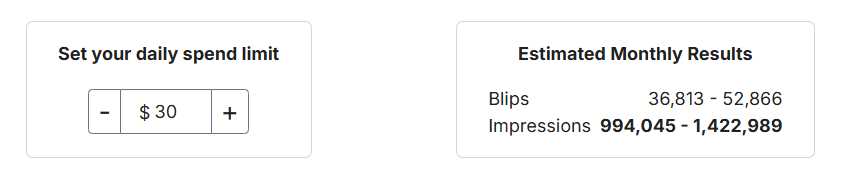
- Start with as little as a few dollars per day, then scale as results appear. Many small businesses in similar suburbs begin testing with $10–20 per day across select boards.
-
Increase budget selectively on high‑value days:
- Weekends for retail and restaurants.
- Peak winter storm days for auto and home services (tire shops and tow services can see demand spikes of 50–100% on heavy snow days).
- Back‑to‑school weeks for education and apparel.
2. Dayparting
-
Schedule your blips to match the specific behavior of your audience:
- Trades and contractors: early morning (5–8 AM), when many leave for job sites.
- Parents: morning school runs (7–9 AM) and late afternoon (3–6 PM).
- Restaurant/bar traffic: evenings and late nights (4–11 PM), especially Thursday–Saturday.
- Concentrating spend into your top 20–30% of hours can dramatically increase impressions per dollar among your core audience when using billboards near New Hope.
3. Geographic optimization
-
Choose a mix of boards in Minneapolis, Spring Lake Park, and New Brighton based on:
- Where your business is located relative to the New Hope area.
- The main routes your customers travel (e.g., to downtown Minneapolis, to northern suburbs, to regional retail centers).
- For a local storefront near New Hope, emphasize boards that capture inbound traffic from Minneapolis back toward the northwest suburbs, where daily return flows can total tens of thousands of vehicles. This gives you effective New Hope billboards exposure even if your physical sign is not directly on a freeway.
4. Creative rotation and testing
-
Run multiple versions of your message:
- Test “Local New Hope Area Experts” vs. “10 Minutes from Home” vs. “Voted #1 by Northwest Suburb Families.”
- Rotate image‑heavy vs. text‑heavy designs.
- Watch which messages correspond with upticks in website traffic, calls, or walk‑ins during your scheduled times. Many advertisers find that small creative tweaks can improve response by 10–30% without changing budget, especially on high‑traffic billboards near New Hope.
Measuring Success in the New Hope Area
While billboard campaigns are primarily an upper‑funnel channel, we can still measure and refine performance to understand the value of billboard advertising near New Hope.
Baseline metrics
- Track website sessions from the New Hope area and adjacent ZIP codes before and during your campaign.
- Monitor direct traffic and branded search volume; increases of 10–20% during campaign windows are a strong indicator of impact.
- If you operate a local storefront, compare foot traffic or point‑of‑sale counts week‑over‑week and year‑over‑year during campaign periods.
Tactical measurement ideas
-
Use unique URLs or QR codes visible on the billboard:
- Example:
YourBrand.com/NewHope or a QR that redirects to a location‑specific landing page.
- Run billboard‑exclusive offers with a simple code (e.g., “Mention NEW HOPE 10 for 10% off”).
- Ask new customers “How did you hear about us?” and log “billboard” as a response option; tracking even 20–30 confirmed billboard mentions per month can help justify and refine ongoing spend while demonstrating the direct impact of New Hope billboards.
Optimization loop
- Start with a 4–6 week test at a moderate daily budget.
-
Review:
- Call logs and appointment volume by day/time.
- Store traffic compared week‑over‑week and year‑over‑year.
- Web analytics by ZIP code and time of day.
-
Shift budget toward:
- The boards delivering the best proximity or resonance for the New Hope area.
- The days/times corresponding with spikes in response.
- Refresh creative every 4–8 weeks to prevent ad fatigue and highlight new offers or seasonal angles. Many OOH studies suggest that fresh creative on this cadence can maintain 15–25% higher engagement than static designs over longer stretches.
Integrating Billboards with Your Broader Marketing
Campaigns near the New Hope area perform best when they reinforce your other channels and extend your reach beyond purely digital impressions.
-
Pair with social and search
- Run geo‑targeted Facebook, Instagram, and search campaigns focusing on ZIP codes in and around New Hope and nearby suburbs like Crystal, Robbinsdale, Plymouth, and Brooklyn Park.
- Use the same headline or image from your billboard creative so people instantly recognize your brand when they go online. Cross‑channel consistency has been shown to increase ad recall by 20–30% in many campaigns.
-
Align with local news and community
- Coordinate messaging with stories or trends covered by outlets like CCX Media, which focuses on northwest suburbs including New Hope, and the Star Tribune
- Use television and online coverage from KARE 11 to time campaigns around major weather events, school stories, or community issues that affect demand for your product or service.
- Sponsor or promote participation in community events highlighted on the City of New Hope
-
Use consistent branding
- Keep the same logo, color palette, and tagline across billboards, print, digital, and in‑store signage so every touchpoint reinforces recall. Consistent branding across 3+ channels can raise purchase intent by up to 20% in many industries.
By understanding how New Hope area residents move, shop, and live—and by using Blip’s flexible platform to meet them on the key corridors of Minneapolis, Spring Lake Park, and New Brighton—we can build digital billboard campaigns that feel local, timely, and measurable. With data‑driven scheduling, localized creative, and thoughtful integration with your other marketing, billboard advertising near New Hope becomes a powerful driver of awareness and real‑world results, giving you a scalable way to turn New Hope billboards into a core part of your growth strategy.