Understanding the St. Andrews Area Market
St. Andrews is an unincorporated community and census-designated place in Richland County, just west of downtown Columbia and east of Lexington. It lies in the triangle formed by I‑20, I‑26, and I‑126, which makes it one of the Columbia area’s highest‑exposure corridors and a key “gateway” between the City of Columbia and communities like Irmo Lexington. This strategic positioning is exactly why billboard advertising near St. Andrews can capture audiences from multiple directions in a single campaign.
Key data points that matter for billboard advertisers:
-
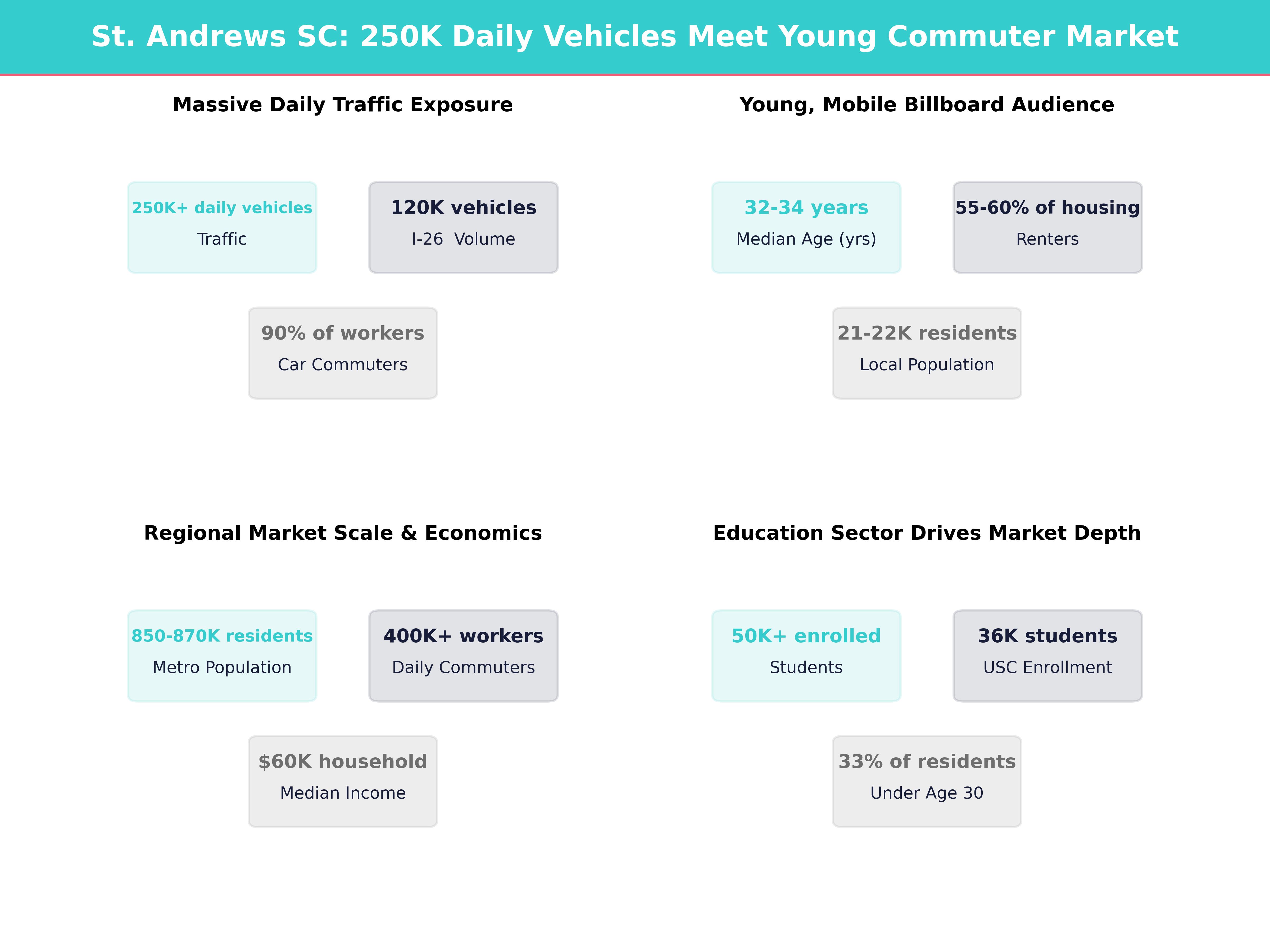
Population density: St. Andrews has roughly 21,000–22,000 residents packed into about 7.3 square miles, or close to 2,900 people per square mile—dense for a suburban area and ideal for hyperlocal messaging. Nearby zip codes along Broad River Road, Bush River Road, and St. Andrews Road add another 30,000+ residents within a 10–15 minute drive, giving St. Andrews billboards a strong built‑in local audience.
-
Columbia metro reach: The Columbia metropolitan area, which includes Richland and Lexington counties, has an estimated 850,000–870,000 residents, with population growth of roughly 5–7% over the last decade. Our boards in Columbia (about 4.7 miles from St. Andrews) and Lexington (about 8.8 miles away) allow us to tap into both counties’ daily movement patterns, where more than 400,000 workers commute on a typical weekday. This makes billboard rental near St. Andrews suitable not only for hyperlocal campaigns but also for regional reach.
-
Interstate convergence: According to the South Carolina Department of Transportation (SCDOT) traffic count maps, stretches of:
- I‑26 near St. Andrews Road can exceed 120,000 vehicles per day, or over 3.6 million vehicle trips per month,
- I‑20 west of I‑26 is often above 100,000 vehicles per day, and
- I‑126 into downtown Columbia regularly handles 60,000–70,000 vehicles per day.
Combined, these corridors provide access to well over 1 million weekly vehicle trips within a short radius of our boards, giving billboards near St. Andrews consistent exposure to heavy commuter flows.
-
Local economic center: St. Andrews sits between major employment and retail nodes:
- Downtown Columbia and the South Carolina State House area, where tens of thousands of state government and private‑sector employees work each weekday,
- The Harbison/Irmo retail district (anchored by Columbiana Centre and big‑box power centers) drawing an estimated 10–12 million shopping visits per year, and
- Office and industrial parks off Bush River Road, Broad River Road, and St. Andrews Road, where many logistics, healthcare, and service employers are based.
Because our billboards serving the St. Andrews area are located along these regional routes, each campaign can efficiently reach both local residents and through‑traffic heading to Columbia, Lexington, and beyond. For brands evaluating billboard advertising near St. Andrews, this balance of commuter and neighborhood traffic ensures that your message stays in front of people where they live, work, and shop. In a typical 4‑week flight, even a moderate buy can generate hundreds of thousands of impressions among drivers who live, work, or shop within 10–15 minutes of St. Andrews.
Who You’re Talking To: Demographics & Lifestyles
To craft effective creative, we need to visualize who is actually driving near St. Andrews and along the boards serving this area. Understanding these audiences helps tailor St. Andrews billboards so they speak directly to the people most likely to see them.
Age & life stage
- The median age in the St. Andrews area is in the low 30s (roughly 32–34 years), younger than the U.S. median (~38). About one‑third of residents are under 30, and roughly 55–60% are under 40, which supports youth‑oriented and family‑oriented messaging.
- With the University of South Carolina in downtown Columbia enrolling around 36,000 students, plus students at Midlands Technical College, Benedict College, and Allen University, the wider Columbia area has a large student and young‑professional cohort. Across these institutions, total enrollment in the region typically exceeds 50,000 students in a given academic year.
-
You’re reaching:
- College students and grad students commuting from apartments near St. Andrews and Broad River Road,
- Young professionals working downtown but living in Lexington, Irmo, or St. Andrews, where average commute times run about 22–25 minutes,
- Families in nearby suburbs like Seven Oaks, Harbison, and Lexington, where 70–80%+ of households own their homes.
Income & housing
- Household incomes in the St. Andrews area are a mix of working‑class and middle‑income. Median household income locally is in the low‑to‑mid $40,000s, while the Columbia metro as a whole is closer to the low‑to‑mid $60,000s. Nearby Lexington and parts of Irmo skew higher, with many neighborhoods posting median household incomes of $70,000–$90,000+.
- St. Andrews itself is more renter‑heavy than the surrounding suburbs: roughly 55–60% of occupied housing units are renter‑occupied, compared to closer to 30–35% in Lexington County overall. This concentration of renters means frequent moves, more need for local services (furniture, storage, insurance, internet, auto repair), and responsiveness to value‑driven offers.
- That means campaigns for value‑oriented retail, quick‑service restaurants, local services, and auto businesses perform well near St. Andrews, while higher‑ticket offerings (healthcare, home improvement, finance, B2B) gain incremental reach through commuters from more affluent suburbs who pass through the corridor daily and encounter billboards near St. Andrews on a regular basis.
Commuter & student flow
- In the Columbia metro, more than 90% of workers commute by car, truck, or van, and carpool plus solo‑driving share hovers around 88–92% depending on the sub‑area. Public transit use is low (typically under 2%), which places even more emphasis on roadside advertising.
-
Thousands of residents drive daily between St. Andrews and:
- Downtown Columbia’s state government, legal, and healthcare campuses (including major employers like Prisma Health and Lexington Medical Center),
- The shopping districts around Harbison Boulevard and the Columbiana Centre, where regional retail draws households from a 30–40‑mile radius,
- Industrial and logistics hubs off I‑26 and I‑20 that support the region’s transportation, warehousing, and manufacturing sectors.
- The presence of major institutions like the State of South Carolina government complex (25,000+ state employees in the Columbia area), Richland County offices, and Lexington County government facilities concentrates stable, year‑round commuter traffic.
This blend of residents, students, and commuters argues for creative that is simple, fast to read, and action‑oriented, with strong value propositions and clear directions. OOH studies consistently show that concise creative can achieve recall rates above 40–50% among drivers who pass a board several times per week, making well‑planned billboard advertising near St. Andrews an efficient way to reach repeat local audiences.
Where the Impressions Are: Traffic Patterns Serving St. Andrews
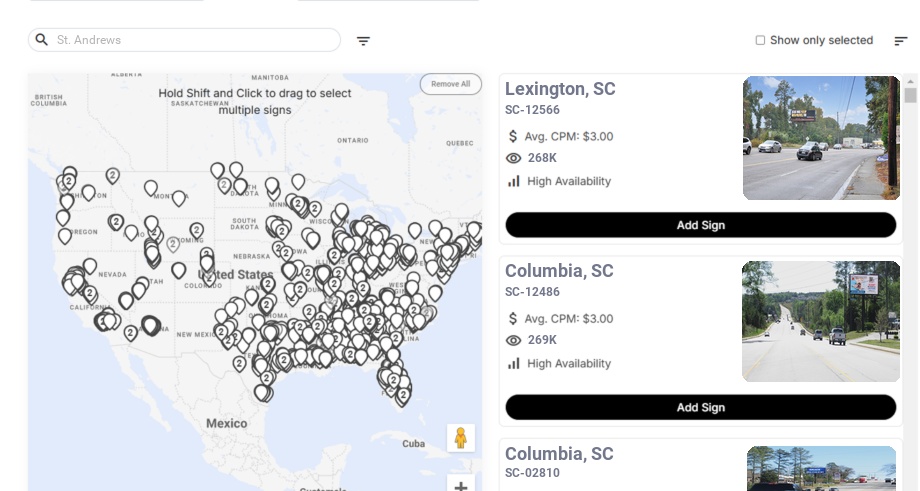
Our five digital billboards serving the St. Andrews area are positioned in Columbia and Lexington, within a 10‑mile radius. Taken together, they provide flexible billboard rental near St. Andrews without the need for a single static structure in the exact ZIP code. The most important corridors to think about are:
- I‑26 and I‑20: These are the primary east–west and northwest–southeast routes linking Columbia, Lexington, Irmo, and the Upstate. SCDOT counts show six‑figure daily vehicle volumes on key segments near St. Andrews. Across a typical month, that translates into 3–4 million vehicle trips per major segment, giving even narrow daypart campaigns substantial reach.
- I‑126 / US‑76 into downtown Columbia: This spur funnels drivers from St. Andrews and Irmo straight into the city center and the City of Columbia government and business district. Peak‑hour volumes spike on weekday mornings (roughly 7–9 a.m.) and late afternoons (4–6 p.m.).
- US‑176 (Broad River Road) and Bush River Road: Heavily used local arterials connecting neighborhoods, apartments, and shopping centers. On some stretches, daily traffic can reach 25,000–35,000 vehicles, ideal for messages requiring slightly longer reading time or QR codes.
- Harbison Boulevard / Lake Murray Boulevard corridor: One of the Columbia area’s busiest retail zones, just northwest of St. Andrews, serving a primary trade area of 100,000+ residents within a 15‑minute drive and strong weekend peaks.
With Blip, we can choose boards and dayparts based on how people actually move:
- Morning inbound: Focus on boards closer to Lexington and Irmo catching traffic heading toward downtown Columbia and St. Andrews job centers. Inbound volumes on I‑26 and I‑20 are often 20–30% higher in the 7–9 a.m. window than mid‑day.
- Afternoon outbound: Shift spend to impressions reaching drivers headed toward Harbison, Irmo, and Lexington retail corridors during the 4–7 p.m. window, when after‑work shopping and dining trips peak.
- Weekend retail & entertainment: Concentrate around routes leading to shopping districts, Riverbanks Zoo & Garden (often over 1 million visitors per year and one of the state’s top paid attractions), and popular Lake Murray access points, which can see summer weekend traffic increases of 20–40% on feeder roads.
Matching your schedule to these flows increases the likelihood that a viewer can act on your message within minutes or hours, not days. OOH effectiveness research shows campaigns timed to peak travel windows can boost response rates by 15–30% compared to “always‑on” schedules with the same total impressions.
Seasonality, Events, and Timing Your Blips
The St. Andrews area follows the rhythms of Columbia’s academic, sports, and government calendars. Smart advertisers lean into those cycles when planning billboard rental near St. Andrews so their budgets are concentrated when traffic and demand are highest.
Academic calendar
- The University of South Carolina alone brings tens of thousands of students back each August, along with thousands of parents and visitors during move‑in, homecoming, and graduation weekends. Local hotel occupancy near downtown and along I‑26/I‑20 regularly spikes to 80–90%+ on peak dates.
-
Enrollment surges:
- Late August–early September (fall semester start)
- January (spring semester start)
- Late April/early May (graduations)
During these windows, we can emphasize:
- Student‑focused offers (food, nightlife, fitness, student housing, tutoring)
- Apartment leasing and furniture/home goods near St. Andrews and Harbison, when leasing activity can be 20–30% above normal
- Banking, insurance, and telecom services for new residents setting up accounts and services in the first 30–60 days after arrival
Sports and major events
- USC Gamecocks football at Williams‑Brice Stadium (capacity around 77,559) generates multiple weekends each fall with heavy regional traffic. Home games frequently draw 70,000+ fans, many of whom travel via I‑26 and I‑20 corridors that pass near our inventory.
- Colonial Life Arena (up to ~18,000 seats) and the Koger Center for the Arts host major concerts and events throughout the year, with many shows drawing 5,000–15,000 attendees and repeated exposure as patrons drive in from Lexington, Irmo, and beyond.
- The South Carolina State Fair at the SC State Fairgrounds
- Local festivals and events promoted by Experience Columbia SC and Discover South Carolina keep weekends busy year‑round, from food festivals and arts events to sports tournaments and holiday celebrations.
Around these dates, we can ramp up short bursts of impressions to:
- Promote restaurants, bars, and entertainment in the St. Andrews and Harbison areas
- Highlight hotel deals, parking, or shuttle services when occupancy and ADR (average daily rate) climb
- Pitch attractions and retail that benefit from out‑of‑town visitors, who typically spend more per visit than locals on dining, shopping, and entertainment
Government and business cycles
- With the South Carolina General Assembly in session typically from January to May, downtown Columbia sees heightened weekday activity, including an influx of legislators, staff, lobbyists, and visitors for hearings and events.
- Many state agencies and major employers maintain 8–5 weekday schedules, making weekday rush hours prime windows for B2B, professional services, and healthcare campaigns. Office‑based workers are often responsible for higher‑value purchases (insurance, financial services, medical specialists), so tailored commuter‑hour messaging can be especially profitable.
Using Blip’s flexible scheduling, we can scale your presence up during these high‑impact periods and scale back in quieter weeks, without locking into a rigid long‑term schedule. This flexibility is valuable in a market where seasonal swings in tourism, sports, and academic activity can shift traffic and spending patterns by 20% or more month‑to‑month, especially for brands counting on billboards near St. Andrews to support short promotional windows.
Crafting Creative That Works Near St. Andrews
Drivers near St. Andrews move at highway and arterial speeds. That demands simple, bold, and instantly understandable creative. The more concise and local your message, the more your St. Andrews billboards will stand out in busy traffic environments.
Design principles for this market
-
6–8 words max: Aim for one main idea per ad. For example:
- “Oil Change Near St. Andrews – Exit 106”
- “New Homes 10 Min From St. Andrews – From $280k”
- High‑contrast colors: Use strong color contrast that stands out in bright South Carolina sun—dark text on a light background or vice versa. Studies show high‑contrast designs can increase legibility distance by 30–50%.
- Big, legible fonts: Clean sans‑serifs (e.g., Helvetica, Arial, Montserrat) at large sizes; avoid script fonts and cluttered layouts. Drivers typically have 3–5 seconds to process a message at interstate speeds.
-
One clear call‑to‑action:
- “Exit at St. Andrews Rd”
- “Order Now – Local Delivery”
- “Book Today – Scan QR”
-
Directional cues: Many viewers know landmarks better than addresses. Use cues like:
- “Next 3 Exits”
- “5 Minutes from Harbison”
- “Across from Columbiana Centre”
Tailoring creative to St. Andrews audiences
-
Commuters: Emphasize time savings, convenience, and daily needs:
- “Skip the DMV Line – Tag & Title Service, 5 Min Ahead”
- “Walk‑In Urgent Care – Open 8–8 Near I‑26”
-
Students & young adults: Lead with price and immediacy:
- “$5 Student Lunch – Broad River Rd”
- “Move‑In Ready Apartments Near USC – Tour This Week”
Younger audiences in the Columbia market are highly mobile; research indicates 70%+ of 18–34‑year‑olds notice digital billboards weekly and are more likely to search online after seeing an OOH ad.
-
Families: Focus on trust, value, and local ownership:
- “Local Pediatric Dentist – New Patient Special”
- “Family Fun Day at Riverbanks – Tickets Online”
Because our boards rotate multiple advertisers, you can test different versions of your creative (e.g., price‑led vs. benefit‑led) and quickly shift impressions to the best performer. Advertisers that A/B test multiple creatives on digital billboards commonly see 10–25% improvements in response by favoring the top‑performing design. This approach works especially well when you are testing what type of billboard advertising near St. Andrews best resonates with your core customers.
Using Blip’s Flexibility in the St. Andrews Area
Blip’s pay‑per‑flip model and scheduling tools let us align your budget to the real behavior of St. Andrews‑area drivers. Instead of locking into a single long‑term static face, you can treat St. Andrews billboards as a flexible, on‑demand channel.
1. Dayparting (time‑of‑day scheduling)
Align your messaging with your best conversion windows:
-
Breakfast and morning commute (6–9 a.m.):
- Coffee shops, breakfast QSRs, radio shows, morning TV news, healthcare reminders.
- Morning drive is often the second‑busiest traffic window of the day, capturing workers with predictable routines.
-
Midday (11 a.m.–2 p.m.):
- Lunch specials, express services, same‑day retail offers.
- Many restaurant operators see 30–40% of weekday traffic in this window, making timely OOH especially powerful.
-
Afternoon school pickup (2–4 p.m.):
- Kids’ activities, after‑school programs, tutoring, pediatric services.
- In family‑heavy zip codes around Harbison and Lexington, this period correlates with increased short car trips.
-
Evening commute (4–7 p.m.):
- Restaurants, grocery stores, gyms, entertainment, home services.
- This is typically the highest‑volume traffic period, responsible for 30–35% of weekday vehicle trips on some corridors.
-
Late night (9 p.m.–midnight):
- Late‑night dining, delivery apps, nightlife near downtown or Harbison.
- Captures service workers getting off shifts and younger audiences headed to or from evening plans.
2. Day‑of‑week strategies
- Weekdays: Prioritize commuters and errand‑runners—great for B2B, medical, auto, and professional services. Many service businesses derive 60–75% of their weekly revenue Monday–Friday.
- Weekends: Focus on shopping, recreation, and dining, especially along routes serving Riverbanks Zoo, Harbison, Irmo, and Lexington. Retailers and attractions often see weekend traffic 1.3–1.5x weekday levels, with corresponding jumps in discretionary spending.
We can schedule more impressions Friday–Sunday if your business depends on weekend traffic, or focus heavily on Monday–Thursday for service‑based businesses that book appointments earlier in the week. This kind of precision is a major advantage of digital billboard rental near St. Andrews compared with traditional static buys.
3. Budget control and testing
Because you pay only for the individual ad plays (blips), we can:
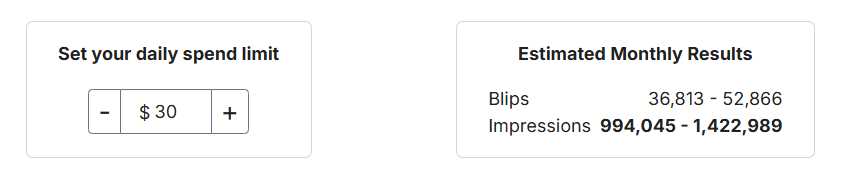
- Start with a modest daily budget to gather directional data—many local advertisers begin with $10–$30 per day and scale as results become clear.
-
Test:
- Different creatives,
- Different boards (Columbia vs. Lexington serving the St. Andrews area),
- Different times of day and days of week.
- Shift spend quickly toward what’s clearly generating more calls, web visits, or in‑store traffic.
National OOH benchmarks suggest that advertisers who actively optimize—changing schedules and creatives based on results at least once a month—can improve cost‑per‑result by 20–40% compared with static, “set‑and‑forget” campaigns. This iterative approach is particularly effective in a dynamic, event‑driven market like Columbia/St. Andrews.
Strategy Examples for Common Advertiser Types
To make the St. Andrews area concrete, here are sample approaches for different kinds of businesses using billboards near St. Andrews.
Local Restaurants & QSR Near St. Andrews
- Target audience: Commuters off I‑26 and I‑20, students, and families in a 5–7‑mile radius spanning St. Andrews, Harbison, and parts of Lexington.
- Best times: 6–9 a.m., 11 a.m.–2 p.m., 4–7 p.m., plus weekends. In many QSRs, these windows cover 70–80% of daily sales.
-
Creative ideas:
- “Kids Eat Free Tue – Exit St. Andrews Rd”
- “$6 Lunch Near Broad River Rd – 2 Min Ahead”
- Tactic: Run lunch‑focused creative weekdays, switch to family dinner or game‑day messaging on Fridays and Saturdays when USC sports or major events are happening. Consider limited‑time offers (“Game Day Wings Special”) to drive urgency; restaurants often see 10–20% sales lifts when pairing OOH with strong time‑bound offers.
Healthcare & Medical Practices
- Target audience: Residents of St. Andrews, Harbison, and surrounding neighborhoods; commuters passing through from Lexington and Irmo. Many healthcare decisions are made within 5–10 miles of home or work.
- Best times: Weekday commute and lunch hours, when families are booking or attending appointments.
-
Creative ideas:
- “Same‑Day Appointments – Family Doctor Near St. Andrews”
- “Urgent Care Open 8–8 – Check In Online”
- Tactic: Use simple directional cues and highlight convenience (extended hours, walk‑ins welcome). Align heavier rotations with flu season or specific campaign pushes (e.g., sports physicals, back‑to‑school immunizations), when clinics can see visit volumes increase 30–50%.
Auto Dealers and Service Centers
- Target audience: Daily commuters on I‑26/I‑20 and local residents along Broad River and Bush River Roads. In the Columbia market, more than 90% of households own at least one vehicle, and many suburban households own two or more.
- Best times: All weekday drive times, Saturday mid‑day (when car shopping peaks).
-
Creative ideas:
- “Oil Change $39.99 – 2 Exits Ahead”
- “Credit Problems? We Can Help – Exit at St. Andrews Rd”
- Tactic: Use price points and financing hooks. Consider separate creatives for service vs. sales, and daypart accordingly (service heavier on weekdays, sales heavier on weekends). Auto advertisers frequently use OOH to support monthly sales pushes (end‑of‑month, model‑year closeouts) where even 5–10 additional vehicle sales makes the campaign highly profitable.
Education, Training, and Colleges
- Target audience: High school grads, working adults, and parents in Richland and Lexington counties—together home to 300,000+ working‑age adults.
- Best times: Early morning, late afternoon, and early evening, when prospective students are commuting or running errands.
-
Creative ideas:
- “Finish Your Degree Online – Enroll This Fall”
- “Career Training in Columbia – Classes Start Aug 15”
- Tactic: Intensify campaigns 6–8 weeks before semester or program starts. Use boards serving the St. Andrews area to reach prospective students from both the Columbia urban core and Lexington suburbs. Training programs that combine OOH with digital retargeting often report application increases of 15–30% over digital alone.
Attractions, Entertainment, and Events
- Target audience: Families, tourists, and locals looking for things to do. In a typical year, the Columbia region hosts hundreds of ticketed events and attracts millions of visitor‑days.
- Best times: Evenings and weekends, plus event‑specific windows (e.g., concert days, festival weekends).
-
Creative ideas:
- “Family Fun at Riverbanks Zoo – Tickets at Riverbanks.org”
- “Concert Tonight – Park Once, Shuttle Available”
- Tactic: Short, high‑frequency bursts in the 7–10 days leading up to the event. Rotate countdown creatives (“3 Days Left,” “Tonight”) as the date approaches. Event organizers who lean on OOH to supplement digital and social typically see walk‑up sales and last‑minute ticket purchases increase by 10–25%.
Integrating Local Media and Community Presence
Digital billboards near the St. Andrews area work best when part of a broader local presence.
- Tie into local news and weather: Many residents follow outlets like The State WLTX, and WIS News. You can run complementary messages that reinforce what people see in TV, streaming, or online ads. Multi‑channel campaigns that combine OOH with TV/online video often deliver reach gains of 15–25% and improve brand recall.
- Leverage community organizations: Align message timing with community events promoted by the City of Columbia, Richland County, Lexington County, and regional tourism promoters like Experience Columbia SC. Sponsoring or advertising around community events can strengthen local brand perception; surveys routinely show 60–70% of residents view brands more favorably when they visibly support local initiatives.
- Promote local pride: St. Andrews‑area residents respond well to messages that emphasize being locally owned, employing local people, or supporting well‑known causes, schools, or teams. Including simple copy like “Locally Owned Since 1998” or “Proud Partner of [Local High School]” can boost trust and response, particularly in service categories like healthcare, auto, and home services. When these messages are featured on billboards near St. Andrews, they reinforce your position as a true local brand.
Measuring and Optimizing Your Campaign
To get the most from our five boards serving the St. Andrews area, we recommend a simple but disciplined measurement plan for your billboard advertising near St. Andrews.
-
Establish a baseline: Before your campaign starts, note your typical weekly:
- Web sessions from the Columbia/Lexington area,
- Phone calls,
- Walk‑in or appointment volumes,
- Retail sales or average daily revenue.
Even 4–6 weeks of baseline data is enough to compare against.
-
Use trackable elements:
- Unique landing pages or promo codes specific to the billboard,
- “Mention this ad for…” offers,
- QR codes (large and simple) for slower arterial routes like Broad River and Bush River Roads, where drivers have a bit more dwell time.
-
Compare by timeframe:
- Look at metrics during weeks when impressions are higher vs. lower.
- Compare weekdays vs. weekends if your schedule differs.
- Many advertisers see measurable uplifts—5–20% increases in calls, web visits, or store traffic—during active OOH flights.
-
Refine targeting:
- Shift impressions to boards and times that correlate with better results.
- Iterate your creative every 4–8 weeks to avoid fatigue and test new angles (price, benefit, urgency, social proof).
By combining localized knowledge of the St. Andrews area with Blip’s flexible, data‑driven scheduling, we can build campaigns that do more than generate impressions—they drive measurable action among the people most likely to become your customers in one of the Columbia region’s most heavily traveled and commercially active corridors. Whether you need ongoing visibility or short bursts of promotion, billboard rental near St. Andrews can be tailored to match your goals, budget, and peak customer activity.